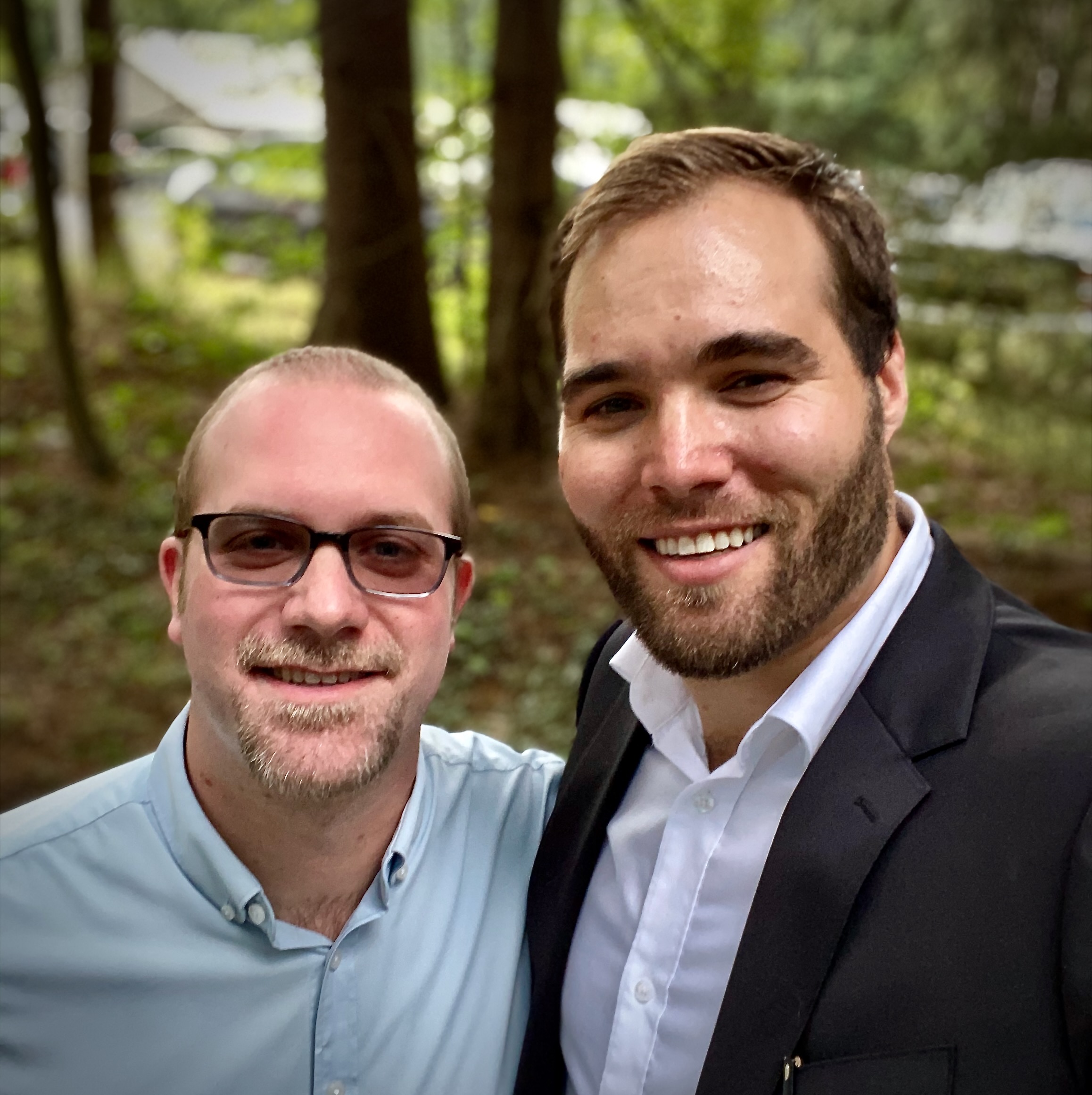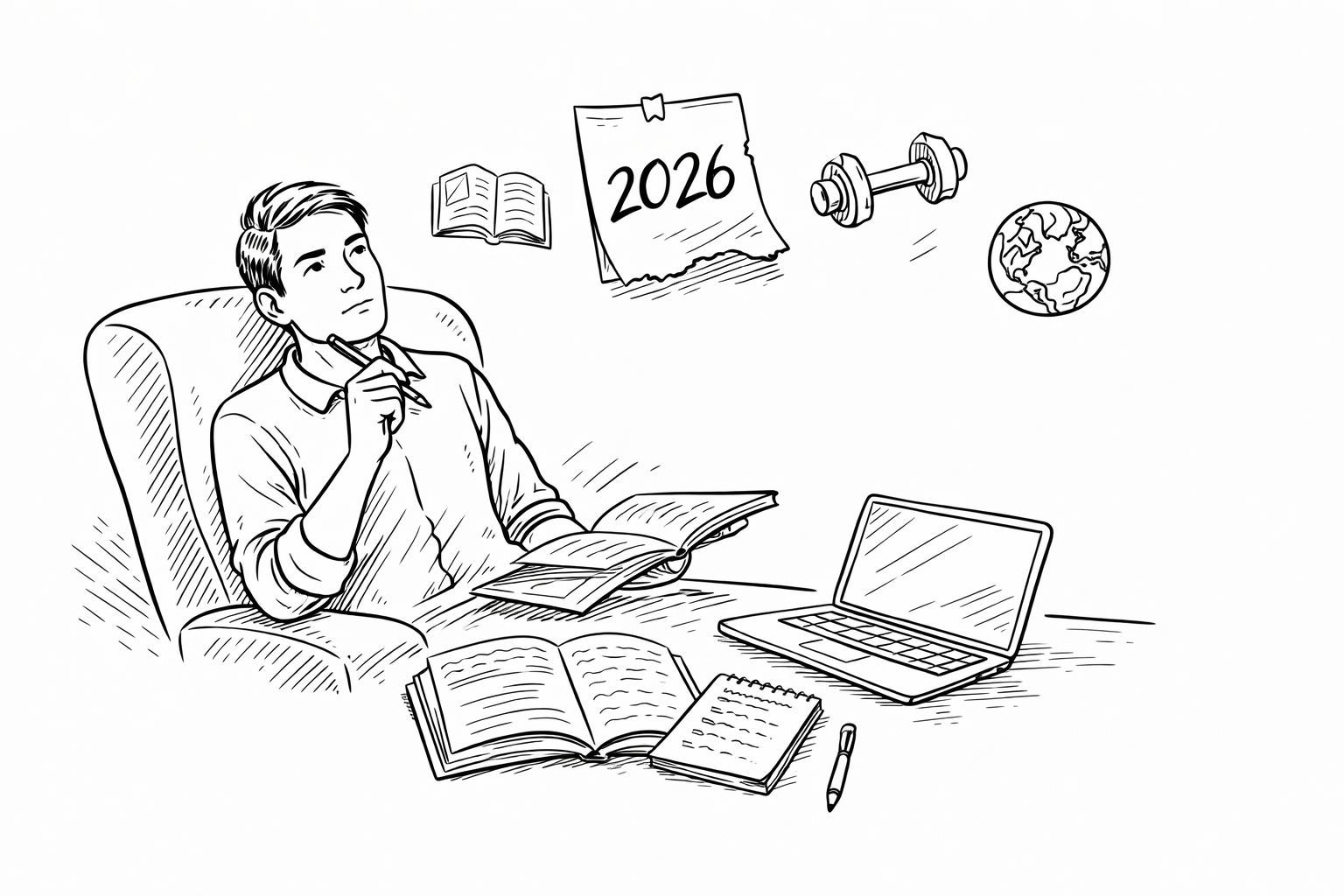
Every year, right on cue, the slogan appears: “New Year, New Me.” And every year, I fall for it. But I’ll give myself a little grace here — my birthday falls right around New Year’s, so it’s not just a calendar reset for me. It’s another year of asking myself the hard questions: Where am I? Where did I think I’d be? Where do I actually want to go?
This year, I was fortunate to kick things off with a trip I took with my sister and my brother-in-law. I’ve always loved starting the year with travel — it’s a pattern I got away from during the pandemic, and getting back to it felt right. But beyond just enjoying the trip, I made two commitments to myself before I left:
- Start the year on a genuinely positive note.
- Don’t start any resolutions until I’m back and settled. That way, I’d beat the typical two-week dropout curve that claims most resolutions before they even have a chance.
So here I am, a little over a month in, and I wanted to share what I’m working on — not as a highlight reel, but as an honest check-in. Because the messy middle of a resolution is where the real growth happens.
Resolution 1: Showing Up for My Body
Let’s start with the one everyone makes and most people abandon: the gym. But my motivation this year isn’t about a number on a scale. As I get closer to 40, I’m thinking less about aesthetics and more about longevity — mobility, flexibility, and making sure I can still move well for decades to come. I don’t want to be the person who waited until something hurt to start paying attention.
Here’s the check-in: I’ve been consistently going to the gym at least three days a week for over a month now. Some weeks I get in more; other weeks, three is what I can manage — and I’m learning to be okay with that. I’ve also started working with a personal trainer occasionally, and that has been a game-changer. Because here’s the thing — I might be a professional in learning and development, but I am not a professional in body mechanics. I can read all the articles and watch all the videos, but there’s still that critical layer of skill validation: someone watching your form and telling you what you can’t see yourself. Sound familiar? It should — it’s the same reason we don’t just hand someone a manual and call it training.
And beyond the physical changes — which are real, and which I’m proud of — the mental health benefits have been the bigger surprise. There’s a growing body of research showing that consistent exercise reduces symptoms of anxiety and depression, improves cognitive function, and strengthens emotional resilience. For me, it’s become the one part of my day that’s entirely mine. No Teams notifications. No competing priorities. Just me, working through something difficult and coming out the other side a little stronger. If you’re in a demanding role and you’re not prioritizing movement, I’d encourage you to reconsider. It doesn’t have to be a gym. It just has to be intentional.
Resolution 2: Getting My Sea Legs in a New Role
The second resolution is about my career. In the last year, a lot changed. I moved to a new state for my partner’s job. I started a new role at a smaller organization. I took on more responsibility while still trying to manage some of what I’d been doing before. It was a lot.
Anyone who’s transitioned jobs knows it really takes about a year to find your footing. That first year is a mix of proving yourself, learning the culture, building relationships, and figuring out where you fit. And now that I’m past that mark, I’m giving myself the space to look back honestly at what’s been accomplished — and what hasn’t.
One of the biggest shifts for me has been moving from large organizations to a smaller one. In larger companies, you might get direction from your manager and some visibility with leadership, but direct interaction with the C-suite was rare. In my current role, I’m in the room with executives regularly — balancing their expectations, advocating for what the research supports, and working to drive the organization forward in alignment with our mission. It’s a different kind of challenge, and it’s pushed me to grow in ways I didn’t anticipate.
So here’s what I’ve taken away from year one — lessons I’m carrying forward and that I hope might be useful for you too, wherever you are in your career.
1. Bring Data to Support Your Ideas
This is one of the most important lessons I’ve reinforced this year, and it applies whether you’re pitching a new initiative or trying to identify which problems to solve first.
When you walk into a room with an idea but no evidence, you’re asking people to trust your gut. And while intuition matters, especially when you’ve built expertise over years, it’s not enough to move a leadership team that’s weighing competing priorities and limited budgets. Data changes the conversation. It shifts you from “I think we should” to “Here’s what we’re seeing, and here’s what the evidence suggests.”
This counts double in L&D, where we’re often fighting the perception that what we do is “soft” or hard to measure. Pull your learner feedback. Show completion trends. Tie your programs to performance outcomes. If you don’t have the data yet, that’s your first project (something I actually had to do when starting in my role) — build the system to start capturing it. The teams that can quantify their impact are the ones that get a seat at the table.
2. Continuously Advocate for What Research Shows
Our field is evolving fast. New tools, new platforms, new theories — it can feel like the ground is constantly shifting. But here’s what I keep coming back to: most of what’s “new” is built on the same proven foundations. Adult learning theory gives us the principles that don’t change, even when the technology does:
- Self-Directed Learning — Adults learn best when they have ownership over what and how they learn. (Knowles, 1975)
- Experiential Learning — Learning is most effective when it’s grounded in real experience, reflection, and application. (Kolb, 1984)
- Transformative Learning — The deepest learning happens when it challenges our assumptions and changes how we see the world. (Mezirow, 1978)
The other thing I want to say here is this: just because an idea doesn’t land the first time doesn’t mean you stop bringing it up. Maybe the timing wasn’t right. Maybe the way you framed it didn’t resonate. Maybe you didn’t have enough supporting evidence. Or maybe now, after they’ve tried something else and seen it fall short, they’re finally ready to hear it. The key is to keep going back to the research. Stay rooted in the foundations. Your credibility is built on consistency, not on being loud.
3. Be Okay with Not Always Being Heard — and Grow Anyway
This is the hardest one, and I’m still working through it. Sometimes, despite your best efforts, there are things in your role you can’t change. Areas where you don’t feel like you’re growing the way you need to in order to continue the trajectory and career path you want. That’s frustrating. It’s real. And it doesn’t mean you give up.
What it means is that you look for growth in places your current role might not provide. For me, that’s looked like joining boards for different organizations. It could also mean volunteering, mentoring, or taking on projects that stretch your skill set in new directions. These experiences keep you connected with what’s happening in your industry and help build capabilities that your day-to-day might not be developing.
And then there’s conferences. I know — if your organization won’t pay for them, it feels like a dead end. But it doesn’t have to be. Here are a few ways to make it work:
- Look for scholarships and grants. Many professional associations and industry organizations offer funding specifically for members who lack employer support. Organizations like ATD, SHRM, and others in the L&D space regularly offer conference scholarships or reduced-rate registrations.
- Check for early-bird and group rates. Planning ahead can cut costs significantly. Some conferences also offer volunteer opportunities that come with complimentary or discounted registration.
- Explore the tax benefits. If you’re self-employed or a sole proprietor, conference registration fees, travel, and related expenses may be deductible as professional development costs under IRS guidelines — as long as they’re directly related to maintaining or improving skills in your current profession. Even if you’re a W-2 employee, it’s worth consulting a tax professional about what might apply to your situation, especially if you have a side business or consulting work. Keep your receipts and documentation.
- Consider virtual options. Many top conferences now offer virtual attendance at a fraction of the cost. You still get access to sessions, resources, and often networking opportunities without the travel expense.
The point is: don’t let your organization’s budget limitations become your own professional ceiling. Your career development is ultimately your responsibility, and there are more paths forward than you might think.
The professionals who keep growing aren’t the ones with perfect circumstances — they’re the ones who refuse to let imperfect circumstances become an excuse to stop.
So, Where Does That Leave Us?
I started this post by admitting I fall for the “New Year, New Me” trap every single year. And maybe that’s okay. Maybe the value isn’t in the slogan itself but in the pause it creates — a moment to reflect, recalibrate, and recommit to the things that matter.
For me, 2026 is about showing up consistently: for my health, for my career, and for the kind of professional I want to become. It’s not glamorous. It’s gym sessions where I’m humbled by my own form and weakness, leadership conversations where I’m still finding my voice, and evenings spent reading when I’d rather be doing anything else.
But I’m learning. And I think that’s the point.
Now I want to hear from you. What resolutions or goals are you working on this year? What’s one lesson you’ve learned in a career transition that you wish someone had told you earlier? I have shared shorter version of this post on LinkedIn, I’d love for you to drop your thoughts in the comments — let’s build the conversation there. And if something here resonated or you just want to connect, my messages are always open. I’m building this blog to be the start of a conversation, not a monologue — and your perspective makes it better.
Let’s keep learning together.
And remember, it’s not too late to start your New Year’s resolution.