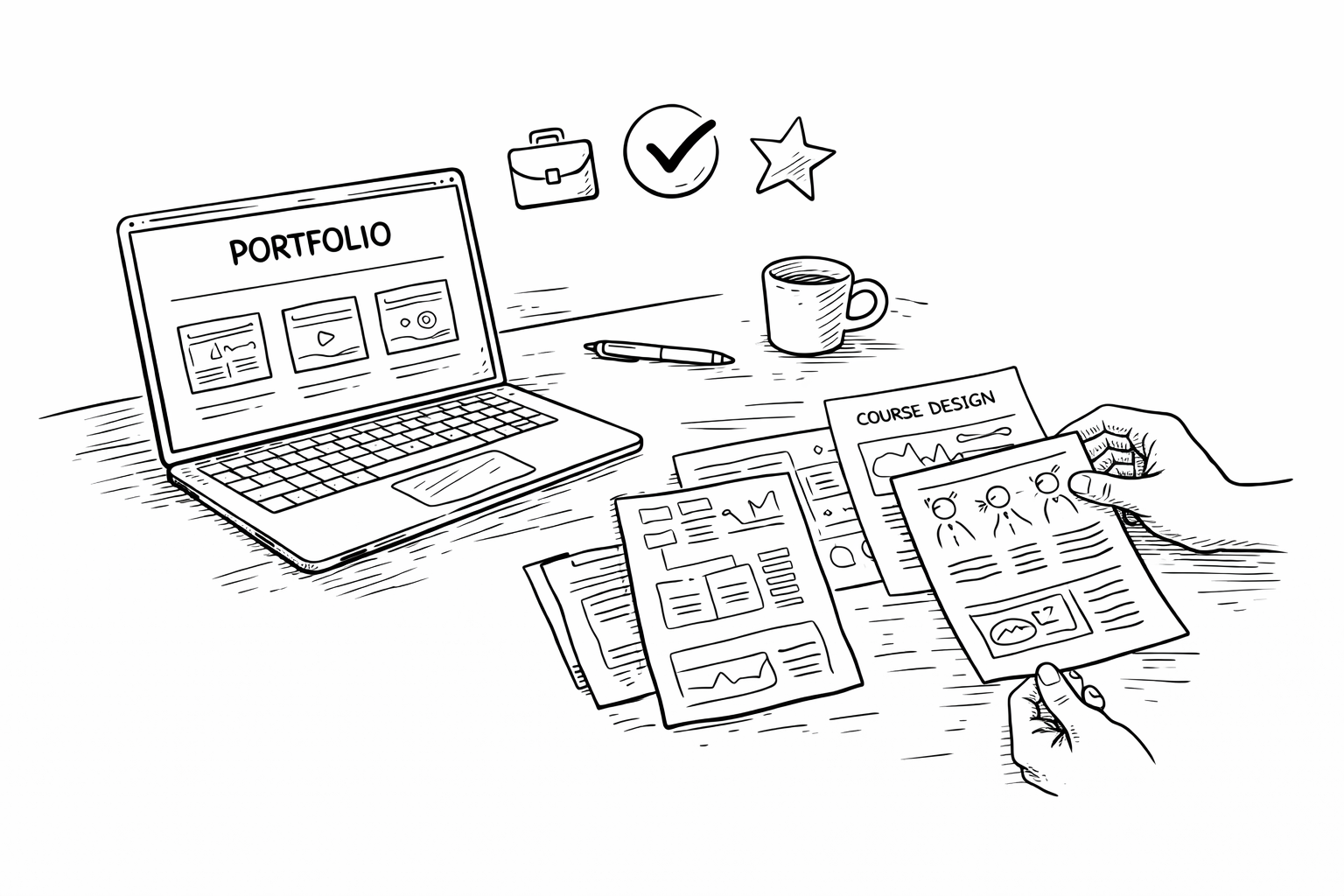
If you're an instructional designer or L&D professional without a portfolio website, I want to challenge you to build one. Not eventually. Not when you have time. Now. Because here's the truth: in a field where our work is literally about designing experiences, how we present ourselves says a lot about what we're capable of.
But I also know the immediate objection, because I've had it myself: "I don't have work I can show."
And you know what? That's completely okay. Let me explain why — and what to do about it.
The Portfolio Problem in L&D
Unlike graphic designers or web developers who can screenshot their work and throw it on Dribbble, instructional designers face a unique challenge. Much of our best work lives behind firewalls, inside corporate LMS platforms, or under contracts that explicitly prevent us from sharing it publicly.
Think about it. The compliance training program you built that reduced onboarding time by 25%? That lives on your company's internal systems. The scenario-based eLearning module that executives loved? It contains proprietary processes and internal data. The knowledge management system you designed from scratch? It's literally your organization's intellectual property.
This isn't a minor inconvenience — it's the reality for most of us. And it stops a lot of talented people from ever building a portfolio at all.
That's a mistake.
Your Portfolio Isn't Just About Showing Work
Here's the mindset shift that changed everything for me: a portfolio website isn't just a gallery of finished products. It's a demonstration of how you think, how you approach problems, and who you are as a professional.
Yes, showing actual samples is powerful when you can. But there's so much more a portfolio can communicate:
- Your process. How do you approach a new project? What does your needs analysis look like? How do you define objectives? You can describe your methodology without revealing a single piece of proprietary content.
- Your impact. Numbers tell a story. "Reduced onboarding time by 50%." "Supported 100%+ organizational growth." "Designed training for 24,000+ employees." Those results belong to you, even if the deliverables belong to your employer.
- Your range. The industries you've worked in, the types of learning you've designed, the tools you've mastered — all of this paints a picture of your capabilities without exposing anything confidential.
- Your voice. A blog, a personal statement, a description of what drives you — these things help people understand not just what you do, but why you do it. And in my experience, that's often what makes someone want to work with you.
How to Handle Work You Can't Show
Let's be practical. When you have work that's protected by IP, company policy, or contracts, here's how to still make it part of your story:
Describe the project, not the product. You can absolutely talk about a project's scope, your role, the challenge you were solving, and the results you achieved — without showing a single screenshot. Focus on the problem, your approach, and the outcome. That's what hiring managers and collaborators actually want to understand anyway.
Make it available upon request. This is something I do on my own portfolio, and I'd encourage you to do the same. Some work can be shared in a private context — a live walkthrough during an interview, a screen share on a call, or a password-protected link. Let people know that additional samples are available and encourage them to reach out. You'd be surprised how many people will take you up on that, and it opens a conversation rather than closing one.
Create personal projects. There's nothing stopping you from building sample courses, writing case studies, or designing mockups specifically for your portfolio. These don't have to be real client work to demonstrate real skill. A well-designed eLearning module on any topic shows that you know how to use the tools, structure content, and create engaging experiences.
Be transparent about it. Don't apologize for having protected work — own it. Saying "Due to contractual agreements, I'm unable to share this project publicly, but I'd be happy to walk you through it in a conversation" is professional. It shows you respect confidentiality, which is actually a strength in our field.
A portfolio that says "I have work I'm proud of and I'd love to tell you about it — let's connect" is infinitely more powerful than no portfolio at all.
Getting Started: It's Simpler Than You Think
You don't need to be a web developer to build a portfolio website. I built this one myself, and while I enjoy the process, the technology isn't the point — the content is. Here are a few approaches depending on your comfort level:
If you want full control: A simple HTML and CSS site hosted on GitHub Pages is free, looks professional, and gives you complete ownership of your content. There are plenty of templates to start from, and you'll learn some valuable skills in the process.
If you want speed: Platforms like WordPress, Wix, or Squarespace let you build a polished site in a weekend. Pick a clean template, add your content, and you're live.
If you want to start even simpler: A well-organized LinkedIn profile with a featured section, project descriptions, and recommendations is a portfolio in its own right. It's not a replacement for a dedicated site, but it's a strong starting point.
The key is to start. You can always refine later.
What Your Portfolio Says About You
At the end of the day, having a portfolio website tells people something important: you care enough about your craft to invest time in presenting it well. In a field where we literally design experiences for other people, showing that you can design an experience for yourself is a powerful statement.
And if there's work you can't show publicly? That's not a limitation — it's an invitation. An invitation for someone to reach out, start a conversation, and learn more about what you've built. Some of the best professional relationships I've formed started with someone saying, "I saw your site and wanted to learn more."
So build the portfolio. Put yourself out there. And don't let the work you can't show stop you from showing who you are.