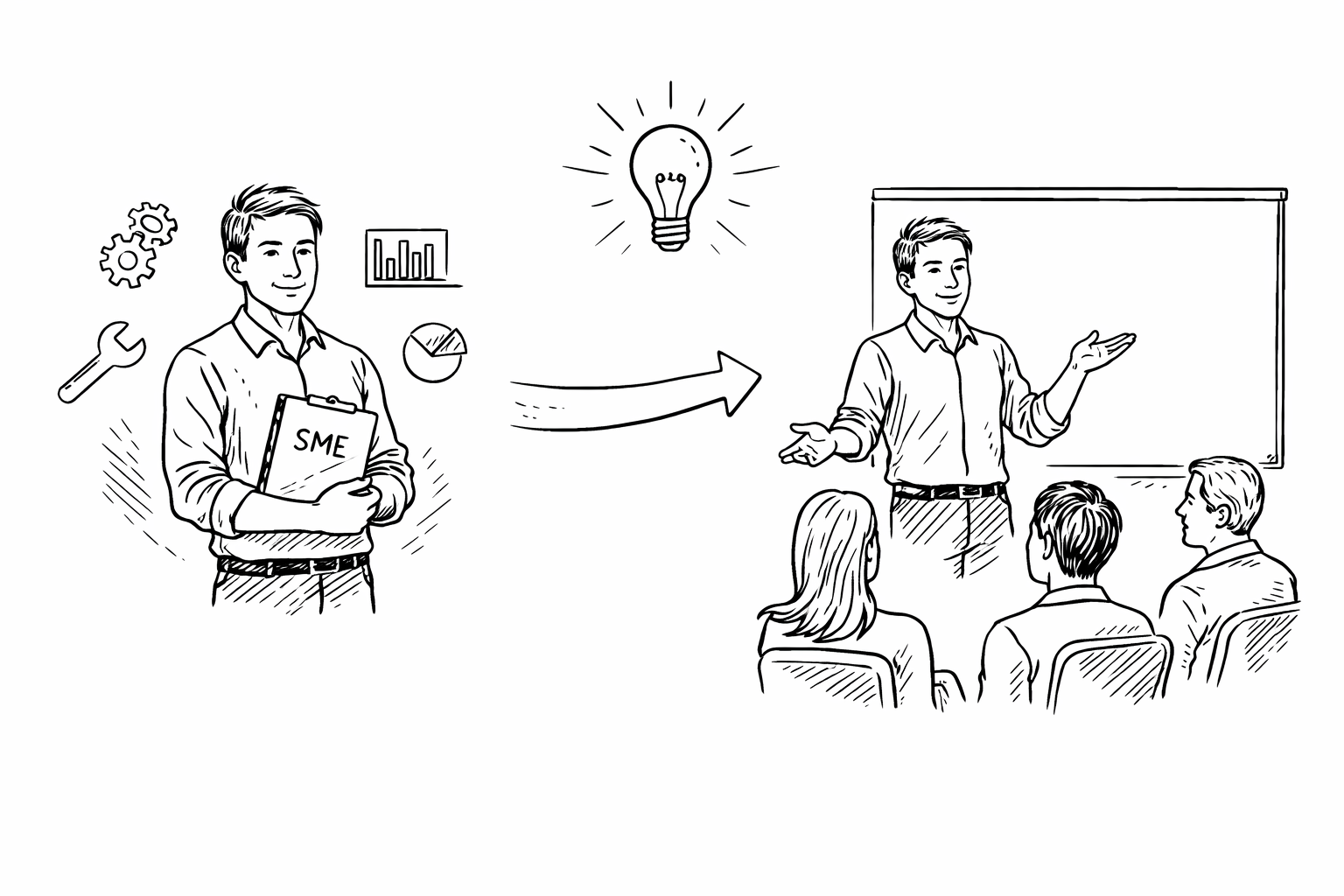
There's a moment that many subject matter experts experience — the moment you realize the thing you love most about your job isn't the job itself. It's teaching someone else how to do it well. If you've ever felt that pull, this post is for you.
I know that feeling because I lived it. I spent over a decade in operations management at Sheetz, Inc., climbing from shift supervisor to quality assurance specialist. I was managing teams of 20+, overseeing $500K in monthly revenue, and solving problems every single day. By every traditional measure, I was succeeding in my role. But the work that lit me up? That was always the training.
The Moment Everything Shifted
Early in my management career, I redesigned the onboarding program for my store. It wasn't a formal assignment — I just saw new hires struggling with the same things over and over, and I thought there had to be a better way. So I rebuilt the process, created job aids, and structured the first few weeks to actually set people up for success.
Turnover dropped 80%.
That result stopped me in my tracks. I hadn't used an authoring tool. I didn't know what ADDIE was. I had zero formal training in instructional design. But I had something that no certification can give you: deep knowledge of the work, the people doing it, and the gap between the two.
That's what makes SMEs so uniquely powerful in the learning space. You don't have to guess what the learner needs because you've been the learner — and the teacher — in real-world conditions.
Why SMEs Make Exceptional Learning Professionals
The L&D industry talks a lot about the importance of partnering with subject matter experts. But what doesn't get discussed enough is what happens when the SME becomes the learning professional. In my experience, that combination is where the magic happens, and here's why.
You understand the real work
Most instructional designers learn about a subject through interviews and documentation reviews. That's valuable, but there's no substitute for having done the work yourself. When I was designing petroleum delivery training at Sheetz, I didn't need someone to explain the safety risks or the daily workflow. I'd lived it. That context meant I could design training that addressed what actually trips people up — not just what the documentation says should trip them up.
You have built-in credibility
One of the biggest challenges in L&D is getting buy-in from the people you're designing for. When learners know you've walked in their shoes, they trust the content. They trust you. That credibility is earned, not designed, and it shows up in everything from how you write scenario-based questions to how you facilitate a live training session.
You know what "good" looks like on the floor
There's a difference between training that looks good in a review meeting and training that actually changes behavior on the job. Former SMEs instinctively design for performance because they know what performance looks like. I've sat in too many training review sessions where a beautifully designed course completely missed the mark operationally. When you've been the person doing the work, you catch those gaps before they make it to production.
The Hard Part: Making the Leap
If you're an SME who's been feeling the pull toward learning and development, I'll be honest with you — the transition isn't always smooth. There are real challenges, and pretending otherwise doesn't help anyone.
Imposter syndrome is real
When I decided to pursue my Master of Science in Instructional Design and Technology at Bloomsburg University, I was surrounded by people who had been in education and design for years. I came from a convenience store chain. There were moments I wondered if I belonged. But here's what I learned: my operational background wasn't a weakness. It was my greatest differentiator. The theory I learned in grad school gave me language and frameworks for things I'd been doing instinctively for years.
You have to learn to let go of being the expert
This one is tricky. As an SME, you're used to being the person with the answers. As a learning professional, your job shifts from having the answers to designing experiences that help others find them. That's a fundamentally different skill. When I moved from managing operations at K&L Gates to designing medical education at Geisinger Commonwealth School of Medicine, I knew nothing about medical curricula. I had to become comfortable being the design expert, not the content expert. That humility made me a better designer.
Formal education helps — but it's not the only path
My master's degree was transformative for me. It gave me the methodology and research foundation to match my instincts. But I also know incredible L&D professionals who built their skills through certifications, self-study, and on-the-job learning. The key is intentionality. Whether you go the academic route or the self-taught route, you need to commit to learning the craft — not just relying on your subject matter knowledge.
The Foundation That Changes Everything
Here's the thing nobody tells you when you're an SME who's great at training: being good at explaining something is not the same as being good at teaching it. And that distinction is everything.
When I started studying instructional design formally, the single biggest shift in my thinking wasn't about tools or technology. It was learning how to write proper learning objectives, how to break a task down into its component steps, and how to truly analyze what a learner needs before you ever build a single slide.
That might sound basic, but it's transformative — and here's why.
As an SME, you carry years of internalized knowledge. You've done the work so many times that huge chunks of it have become automatic. You don't think about the steps anymore — you just do them. And when you go to teach someone, you unconsciously skip over the things that feel obvious to you. The problem is, those "obvious" things are often exactly where new learners get stuck.
The biggest weakness of an SME teaching others isn't a lack of knowledge — it's the assumption that your audience shares your starting point. We forget what it was like to not know what we know.
Learning the foundations of instructional design fixes this. When you learn to write clear, measurable objectives, you're forced to define exactly what the learner should be able to do when they're done — not what you want to cover, but what they need to walk away with. When you learn task analysis, you break every process down to its smallest steps, which exposes all those gaps where your expertise has been filling in blanks that a new learner can't fill yet.
And when you learn audience analysis — really learn it — you start every project by asking: What does this person already know? What assumptions am I making about their background? What's the actual gap between where they are and where they need to be?
Before I understood these foundations, I was building training based on what I thought people needed to hear. After? I was designing learning experiences based on what they actually needed to do — and meeting them exactly where they were. The results weren't even close.
This is honestly the biggest gift that studying L&D gives you as an SME. You already have the knowledge. The foundations teach you how to deliver it in a way that actually lands — to truly analyze what you know, make sure you're covering everything, and stop assuming your audience is starting from the same place you are.
Five Things I'd Tell Every SME Considering the Shift
Looking back on my own journey from frontline manager to leading learning strategy for a healthcare organization, here's what I wish someone had told me:
1. Start where you are. You don't need permission to redesign a process, create a job aid, or improve how your team trains new hires. Some of the most impactful learning work happens informally. Build a portfolio of those wins — they matter more than you think.
2. Learn the foundations — not just the frameworks. Yes, familiarize yourself with ADDIE, SAM, and the Kirkpatrick Model. But more importantly, learn how to write learning objectives, how to conduct a task analysis, and how to assess your audience. These aren't just academic exercises — they're the tools that turn your expertise into something a learner can actually absorb. The frameworks give you a shared vocabulary with other L&D professionals, but the foundations are what make your training actually work.
3. Get comfortable with technology — but don't let it intimidate you. Tools like Articulate 360, Camtasia, and Vyond are learnable. I promise. Your deep understanding of the content is the hard part, and you already have that. The tools are just the medium. Start with one, get comfortable, and expand from there.
4. Find your niche. Your SME background is your superpower. I've worked in retail operations, global law firm management, medical education, and healthcare. Each domain gave me unique perspective that other designers in those spaces simply didn't have. Don't run from your background — lean into it.
5. Embrace AI as an accelerator, not a threat. The L&D landscape is evolving fast, and AI is changing how we create, deliver, and measure learning. I've been an early adopter of AI-enhanced learning tools, and what I've found is that they amplify good design thinking — they don't replace it. Your human expertise and judgment are more valuable than ever.
The Bigger Picture
The learning and development industry needs more people who've done the work. We need designers who've managed a P&L, who've worked a night shift, who've navigated a compliance audit, who've calmed down an upset customer. We need people who understand that training isn't just about content delivery — it's about changing how people think and act in real situations.
If you're an SME with a passion for helping people grow, you don't just belong in L&D. You might be exactly what the industry needs. The path from subject matter expert to learning professional isn't always linear, and it's rarely easy. But if you have the passion — genuine, can't-stop-thinking-about-it passion — the rest is learnable.
I'm proof of that. And I'd bet you could be too.